

Visit Château de Chambord
Planning a visit to Château de Chambord requires a thorough understanding of its monumental nature and the historical context in which it was created. Located in the Loir-et-Cher department, this architectural giant was not conceived as a permanent residence or an administrative palace, but rather as a hunting lodge for King Francis I. The monarch wanted a place that would proclaim the magnificence of his kingdom and the grandeur of the French Crown to the world, especially to his eternal rival, Charles V. Today, as a UNESCO World Heritage Site, Chambord attracts visitors from every corner of the globe. The experience is best enjoyed when approached from both a logistical perspective and an understanding of the internal visitor flow.
The visit begins by passing through the large parking areas nestled within the forest, designed to minimize the visual impact of vehicles on the surrounding natural environment. Approaching on foot, the visual encounter with the northern façade is unforgettable. The immense structure of the castle rises against the sky, revealing a rigid symmetry interrupted only by the decorative complexity of its rooftops. Once through the main entrance and security checks, visitors find themselves in the inner courtyard. Here, the quadrangular layout becomes evident, with the keep standing at the center, the most ancestral and aristocratic part of the structure. The exploration route develops vertically, revolving around the central staircase. On the ground floor, before beginning the ascent, it is advisable to visit the spacious eighteenth-century kitchens. These areas provide a realistic glimpse into the complex planning machine required to feed the royal court during the king’s stays, events that involved thousands of nobles, soldiers, and servants. Adjacent to the kitchens, an audiovisual room screens an introductory film summarizing the evolution of the castle’s architectural style through digital 3D reconstructions, a useful tool for orientation before exploring the upper floors.
Ascending the steps of the majestic staircase, visitors arrive on the first floor, which is primarily dedicated to the royal apartments. Here, the route unfolds through the different historical periods represented within the castle. The wing of Francis I evokes the charm of the early sixteenth century, characterized by rooms furnished with imposing wooden furniture and monumental fireplaces. In contrast, the apartments later occupied by Louis XIV reflect the evolution toward Baroque classicism, with walls adorned by precious tapestries from the renowned Gobelins Manufactory and family portraits designed to emphasize the continuity of royal power. Walking through these rooms reveals numerous symbolic details, including more than eight hundred representations of the salamander, the heraldic emblem of Francis I, carved into walls and coffered ceilings.
The second floor houses rooms dedicated to the history of hunting, an activity that played a central role in life at Chambord Castle. Collections of ancient art are also displayed here. However, the most spectacular moment of the visit comes when stepping out onto the magnificent panoramic terraces. These spaces suspended between sky and earth offered the court a privileged vantage point from which to observe hunting parties, knightly tournaments, and military parades taking place in the vast park below. From the terraces, visitors can admire up close the extraordinary network of chimneys, dormer windows, lanterns, and spires that crown the castle, forming a fairytale-like skyline reminiscent of a small medieval village suspended in the air.
To further enrich the experience, renting the HistoPad at the ticket office is highly recommended. Thanks to augmented reality technology, this multimedia device digitally reconstructs the rooms as they appeared during the Renaissance, compensating for the absence of many original furnishings that were dispersed during the French Revolution. A thorough visit of the interiors requires approximately two and a half hours, to which at least another two hours should be added to enjoy the formal gardens and stroll along the paths bordering the Cosson River. The exploration can be undertaken independently or with the assistance of official guided tours available in several languages. These tours provide exclusive access to certain areas normally closed to the public, such as the atmospheric attic spaces of the keep.
What to See at Château de Chambord
A treasure chest of engineering and artistic wonder, this is the definition of Château de Chambord, which blends the structural tradition of the French Middle Ages with the geometric aesthetics of the Italian Renaissance. Every corner of the palace contains hidden symbols and innovative architectural solutions that deserve closer examination. Knowing exactly what to see allows visitors to navigate the vastness of the building while focusing their attention on its most historically and artistically significant features.
The double-helix staircase, positioned at the exact center of the keep, is Chambord’s main attraction and its undisputed engineering masterpiece. Tradition attributes the design to Leonardo da Vinci, who spent the final years of his life in Amboise as an honored guest of Francis I. The structure consists of two superimposed spiral staircases revolving around a perforated central core. This ingenious design allows two people to ascend and descend simultaneously, seeing one another through the central openings without ever meeting, as the stairways remain parallel throughout the route.
The staircase serves not only to connect the floors but also to organize the entire Greek-cross layout of the keep, dividing each level into four distinct wings. Another important feature to observe carefully is the coffered ceilings on the first and second floors. The barrel vaults of the four arms of the Greek cross are decorated with an abundance of high-relief sculptures. The dominant motifs are the letter F, the monogram of Francis I, and the salamander, a mythical amphibian believed at the time to be capable of living in fire and extinguishing it with its own body. The king’s motto, “I nourish the good fire and extinguish the bad one,” is implicitly referenced through these figures, which were intended to celebrate the monarch’s virtue and courage in the face of political adversity.
Within the royal apartments, the Chamber of Francis I is an essential stop for anyone visiting the castle. Located in the eastern wing to capture the morning light, it retains the solemn atmosphere of the sixteenth century. Although little of the original furniture remains, the grandeur of the fireplace and its proximity to the king’s private study offer valuable insight into the ruler’s personal life.
A completely different style characterizes the eighteenth-century apartments located in the center of the keep. These rooms were transformed at the request of distinguished later occupants, including the exiled king Stanisław Leszczyński and the Marshal of Saxony. Here, the strict forms of the Renaissance give way to elegant wood paneling, lowered ceilings designed to retain heat, and marble fireplaces decorated in the style of Louis XV.
Moving to the western wing, visitors reach the majestic Royal Chapel, the largest interior space in the castle. Its construction began under Francis I and required several decades, being completed only during the reign of Louis XIV under the supervision of architect Jules Hardouin-Mansart. The chapel impresses through its refined monumentality: the light filtering through the large windows highlights the essential classical lines and the harmonious blend of religious symbolism with representations of absolute monarchic power.
Outside, the eye is inevitably drawn to the central lantern tower rising fifty-six meters high. This slender structure towers above the dramatic interior staircase and culminates in a large royal crown surmounted by the Fleur-de-lis of France.
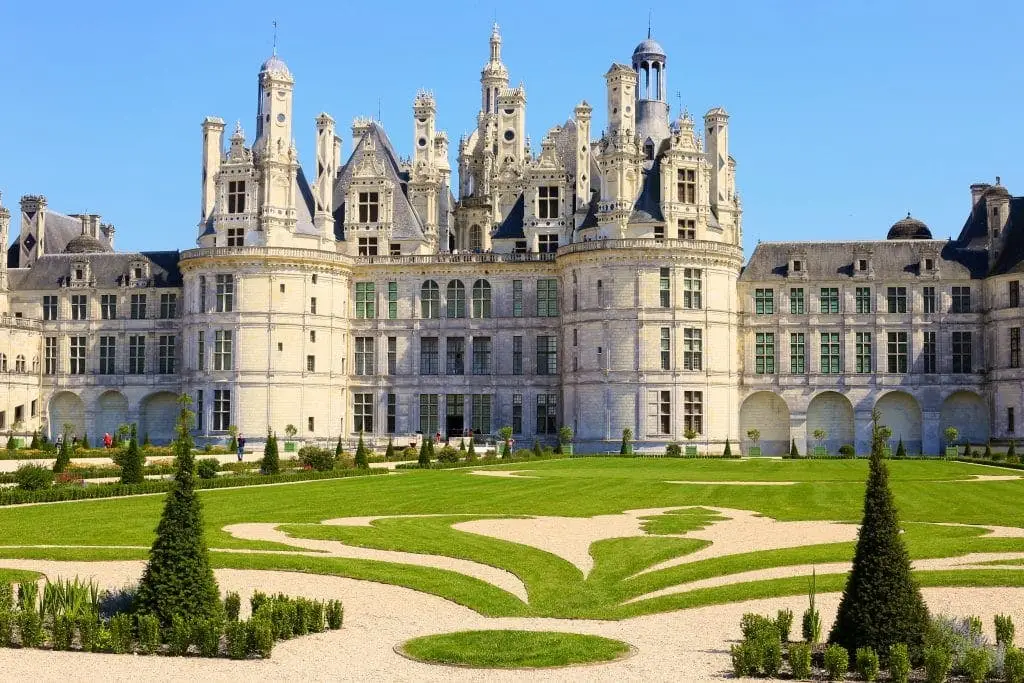
The roofscape of Chambord itself is considered a unique work of art. The contrast between the rigorous geometry of the lower façades and the rich decoration of the upper section creates an extraordinarily theatrical overall vision. Here, visitors can admire hundreds of imaginative chimneys designed to resemble ancient columns, skylights decorated with slate inlays reminiscent of Italian marble, and elegant spires reaching toward the sky.
To conclude the visit, it is essential to admire the magnificent French Formal Gardens, restored to their former splendor in 2017 thanks to meticulous historical and archaeological research. Covering six hectares along the castle’s northern façade, the gardens faithfully recreate the geometric flowerbeds, perfectly symmetrical pathways, and carefully trimmed plants that follow the original 1734 design commissioned by Louis XV.
Beyond the gardens lies the immense enclosed Chambord Estate, extending across five thousand hectares and surrounded by a wall measuring thirty-two kilometers in length. This extraordinary natural space is not only an active hunting reserve but also a sanctuary for wildlife, where visitors may spot deer and wild boar in their natural habitat.
Passes and Bundles
Useful info
Opening hours
Chateau de Chambord welcomes visitors throughout the year, with seasonal opening hours that vary slightly. Arrive early in the morning for a quieter atmosphere and softer light for photos. Always check the latest schedule before your visit, especially on holidays.
Location
Chateau de Chambord sits in the heart of France’s beautiful Loire Valley, surrounded by forests, gardens, and a vast estate. Its peaceful countryside setting makes the castle feel even more magical, far from the rush of busy city streets.
How to get there
Getting to Chateau de Chambord is part of the adventure. Most visitors arrive by car from Paris or nearby Loire Valley towns. Trains connect to nearby stations, followed by shuttle buses or taxis. The scenic journey is well worth the effort.
Best time to visit
Spring and autumn are wonderful times to visit Chateau de Chambord. Pleasant temperatures, colorful landscapes, and smaller crowds create a more relaxed experience. Summer offers lively events, while winter brings a peaceful atmosphere and unique charm.
Duration of the visit
Plan to spend at least three to four hours exploring Chateau de Chambord. This gives you enough time to admire the castle interiors, climb the famous staircase, stroll through the gardens, and enjoy the impressive views across the estate.
Accessibility
Chateau de Chambord offers accessibility features to help more visitors enjoy the site comfortably. Accessible routes, adapted facilities, and visitor services are available in many areas. Check ahead for specific assistance and accessibility information.
Opening hours
Chateau de Chambord welcomes visitors throughout the year, with seasonal opening hours that vary slightly. Arrive early in the morning for a quieter atmosphere and softer light for photos. Always check the latest schedule before your visit, especially on holidays.
Location
Chateau de Chambord sits in the heart of France’s beautiful Loire Valley, surrounded by forests, gardens, and a vast estate. Its peaceful countryside setting makes the castle feel even more magical, far from the rush of busy city streets.
How to get there
Getting to Chateau de Chambord is part of the adventure. Most visitors arrive by car from Paris or nearby Loire Valley towns. Trains connect to nearby stations, followed by shuttle buses or taxis. The scenic journey is well worth the effort.
Best time to visit
Spring and autumn are wonderful times to visit Chateau de Chambord. Pleasant temperatures, colorful landscapes, and smaller crowds create a more relaxed experience. Summer offers lively events, while winter brings a peaceful atmosphere and unique charm.
Duration of the visit
Plan to spend at least three to four hours exploring Chateau de Chambord. This gives you enough time to admire the castle interiors, climb the famous staircase, stroll through the gardens, and enjoy the impressive views across the estate.
Accessibility
Chateau de Chambord offers accessibility features to help more visitors enjoy the site comfortably. Accessible routes, adapted facilities, and visitor services are available in many areas. Check ahead for specific assistance and accessibility information.
Château de Chambord Map
